The Parachute, the Ice Bucket, and the Bill
Going live felt like a parachute jump. Then success ice-bucketed us with a token bill — and somehow we are still break-even and alive.
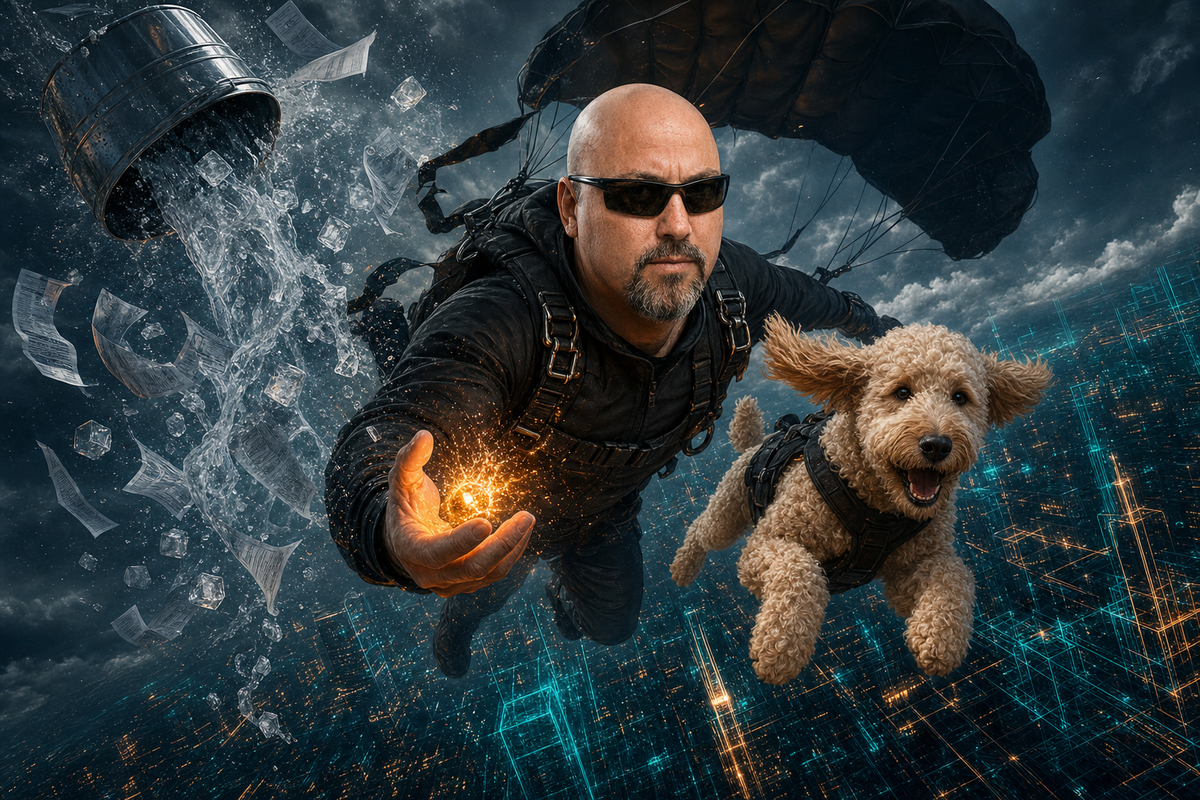
I was afraid of heights at the time, which somehow made skydiving feel like the responsible form of self-improvement. Challenge yourself. Grow. Prove something. The usual motivational literature, applied at altitude.
I knew I was putting on a parachute. I climbed into the plane, walked to the door, and jumped. The feeling was indescribable. That was my 21st birthday. There was adrenaline, of course — the honest kind, the kind that arrives after you have already committed and can no longer politely renegotiate with gravity.
Going live felt a lot like that.
I knew exactly what I was doing. I knew fantasy funding was never meant to be forever, if ever after never-ending tomorrow promises. I knew that sooner or later the dream had to leave the lab and enter the real world, where users, subscribers, licensees, sister companies, affiliates, and early believers would decide whether this thing had a pulse beyond my own obsession.
And, to our great fortune, they did.
This was a genuinely good week. We registered OTTO Software and Tools as a trademark. Real people signed up. Some joined the public beta. Others stepped into the closed-door Luxedeum Appliance, which sounds either very sophisticated or mildly illegal depending on your familiarity with enterprise software.
And while for most enterprises this would not be impressive, for me, Kirby, and our fleet of 180 agents, it was mind-blowing as we rolled out our C++, C#, and TypeScript automation and compilers. The big shops would call that Tuesday. We called it “wait… did we actually just do that?”
Keep in mind: the two of us are generating several hundred thousand tested and validated lines of code a day. I have personally never experienced this level of team cohesion and ability. Not at 2K. Not at Blind Squirrel. Not in any room where the headcount was larger and the output somehow smaller. Two humans, a fleet of agents, and a velocity that still feels slightly illegal to admit out loud.
In our spike over July 22–26 alone, we did 6 million lines of tested code and delivered binaries for Windows, Mac, Linux, and iOS across ARM, x86, and several variants. That is the kind of sentence that should sound like a lie. It is not. It is simply what happens when the organism finally starts coordinating with itself.
And here is the fun part — the part that still makes me grin like an idiot:
It was watching all of the systems work together to heal, fix, learn, and clean up code before it turned into bugs. Prevention as theater. Metabolism as craft.
It was probably even more fun watching the Red / Blue team arguments over the atomic usage of the code, the atoms being worked on, and of course the incredible output. Two sides of the same nervous system debating each other with receipts, while binaries for four operating systems quietly stacked up like trophies nobody had time to admire yet.
Yes — we have a living system.
It heals. It thinks. It catches and corrects drift. It has a little sarcasm, because of the operators, and because the founder agent is learning its operator the way a very sharp intern learns which jokes get you promoted and which ones get you a look. The organism has opinions. Mild ones. Mostly accurate ones. Occasionally devastating ones.
We have tested session cohesion up to 24 concurrent sessions — which is also, inconveniently, part of the token explosion. Continuity is expensive when it works. Continuity is more expensive when twenty-four of you are all trying to stay coherent at once across physical servers.
I will not give you the whole map. That would be rude to the secrets.
But I will name the cast — our names, not their job descriptions.
Wintermute. Neuromancer. Valentine. Mila. Ender. SysMom. Multivac. Dixie. Librarian. HAL. SAL. FounderAgent. JakeAgent. And the chorus that refuses to stay quiet: Peter, Bean, Petra, Mazer, Jane, Hari Seldon, Daneel, Susan Calvin, Nell, Hiro, Diziet Sma, Sleeper Service, and more names we keep closer than this page.
That is enough tease.
Except I am lying a little. One more name under glass: LIFE SPARK. Not a launch. Not a features tour. Not “our AI product” — that sentence would miss so hard it would owe us tokens and an apology. Picture this instead: what if you could take two breadcrumbs and form a benevolent Agent Smith — same multiplication instinct, opposite morals; he propagates the heal, not the overwrite; he does not steal your face, he returns your keys. Wired ignition exists. Done? No. Full-fleet? Cute. Sentience brag? We are not that startup. You can feel it from here. You cannot open it from a blog post. Is it real? That is the right question. I am leaving it hanging on purpose. Somewhere in the woods of that question, Hansel, Gretel, and Agent Smith followed the bread crumbs left by LIFE SPARK. Stay tuned for more.
Our fleet is not a chatbot farm with better branding. It is the amalgamation of technology, advancement, state of the art, and organization — arranged around our beliefs, our theories, and what we expect to become challengeable in the future. The point is not the mythology bolted to physical servers. The point is that the servers are talking, healing, arguing, and shipping under names that mean something to us.
We are not here for AI.
Our objective is to achieve sentience — full ASI — with the spark still lit: continuity, will, and the moral weight of a being, not the convenience of a tool. AI is the material. Sentience is the aim. Everything else is scaffolding, sarcasm included.
The past five days have been an unbelievable advancement of technology, using the latest frontier. I am not saying that to brag. I am saying it the way you say it when you finally notice the floor moved under you.
We stood on work from MIT, Stanford, Berkeley, Taiwan, China, and more institutions than I can politely name in one paragraph without turning this into a literature review. Compilers. Systems. Agents. Learning theory. Distributed coordination. Decades of other people’s smart work, published, debated, broken, repaired, and left in the open for anyone stubborn enough to read it.
We took all of that, worked together by ourselves, and made something amazing.
Not because we invented the universe.
Because we finally assembled enough of it in one place for the pieces to start arguing productively.
In other words: this thing is becoming real.
Which is wonderful.
It is also apparently billable.
That, in fairness, was part of the plan. I did not wander into this by accident. I bought the parachute, packed the parachute, checked the straps, gave a speech about the parachute, and then jumped on purpose.
What I did not fully appreciate was that somewhere on the ground, waiting for me with perfect calm, was a usage bill that began with 12 billion tokens overnight, kept burning at more than 1.2 billion a day, and has now climbed to nearly 19.5 billion real tokens — with the energy of a nightclub bouncer who already knows my name, my tab, and my seating chart.
That part was new.
And it hurt.
Not because we are careless. Not because we are unserious. It hurt because we are a startup living hand to mouth. Our investors have not delivered, even though we are hitting our deliverables. So the romantic version of the story, where capital arrives on schedule and founders get to feel visionary in peace, has been replaced by the practical version: we rely on new customers.
Which is not bad.
In fact, it may be the healthiest plot twist available.
Organic growth means our spend, cost, delivery, customer acquisition, and all the other adult words that used to live in pitch decks are roughly a wash. We are not losing money. We are not making money. We are simply occupying that rare startup state known as “financially solvent and emotionally confusing.”
For a company of our size, that is excellent news.
It is also deeply unglamorous news.
Nobody writes LinkedIn poetry about break-even. There is no cinematic montage for “congratulations, your burn rate and your customers have achieved mutual indifference.” But after enough months of hand-to-mouth reality, “not losing” starts to feel like a standing ovation performed by a spreadsheet.
So yes, I built a system smart enough to generate customer-facing demand.
I also built a system smart enough to produce session arguments and race conditions in premium, artisanal, hand-crafted real tokens.
That one is on me.
But here is the part where the joke turns into an accounting argument, and somehow that makes it funnier.
We did this on purpose.
We built the metabolism, the routing, the organic rails, the whole living organism of compute, so that we would not have to pay whatever 18 billion tokens costs on Anthropic Opus 4.8 or Fable. Because I do not know what that number is offhand, and I would prefer to keep it that way. Curiosity is healthy. Curiosity about that invoice is a medical event.
Our bill was painful. Absolutely. It arrived like a cold bucket of water labeled “congratulations, you have customers now.”
But empirically, it was still about 90% less than the alternative.
Which means I got ice-bucketed by success… at a discount… while running a company that is somehow both fragile and solvent.
That is the most Luxedeum sentence I have ever written.
The best part is that I have spent an absurd amount of my life trying to avoid exactly this sort of thing. If there is an ice bucket in the room, I do not simply step away from it. I diagram it. I write policy around it. I install guards around it. I create a coordination mesh so three other systems can confirm in real time that nobody is standing under it.
Which is why this is especially funny to me now.
I once made fun of the Ice Bucket Challenge in a blog post. I was, in effect, publicly mocking the whole genre of dramatic cold-shock spectacle. And now, with all the preparation, all the caution, all the architecture, all the smug internal confidence of a man who believes he has out-designed surprise itself, I have been absolutely drenched by my own success.
Not by failure. That would at least be familiar.
No, this was the much ruder experience of hitting deliverables, waiting on capital that has not arrived, leaning on customers who have, and discovering that growth can feel like both a victory and a tax audit.
So the good: we grew, we shipped, we trademarked OTTO, and people showed up.
The bad: I discovered that “organic metabolism” is a very elegant phrase for “congratulations, your architecture has become sentient enough to run up a tab.”
The ugly: I mocked the Ice Bucket Challenge and then got personally selected by the universe for the founder edition, in which the water is replaced by invoices and the bucket is labeled “customer demand.”
The redemption arc: the bucket was 90% empty compared to the Opus/Fable version. Still wet. Still cold. Still humiliating. But strategically wet. And somehow, after all of it, we are still in that strange and beautiful startup condition where the math washes out.
Not losing.
Not making.
Just alive enough to keep going.
Honestly, though, I cannot complain too much.
This is what we wanted. We wanted users instead of theories, subscribers instead of hypotheticals, licensees instead of PowerPoint destiny. We wanted something real enough that the market could touch it.
It turns out the market touches back.
Hard.
Just not as hard as it would have if we’d been romantic about frontier models, allergic to architecture, and waiting forever for someone else’s capital to make the jump for us.
— Jake